Meditations on Whitney Houston’s artistic genius and creative legacy
Holding Lightning: The Life, Loves, and Art of Whitney Houston by Emily Lordi (Harper Collins)
In a 15-year span (1985-2000) Whitney Houston became a standard bearer for dance pop, pop balladry and contemporary R&B inflected singing. Though many music critics found her music unchallenging and formulaic, and Black cultural critics lamented the lack of overt funk in her music and a sanitized image, her stellar commercial record belied these concerns. She was embraced globally by adults and kids alike. Arguably, every earnest warbler auditioning for a shot at a beauty pageant, talent show or televised competition (e.g., American Idol, The Voice) has probably listened to her obsessively and idolized her as the blueprint for success.
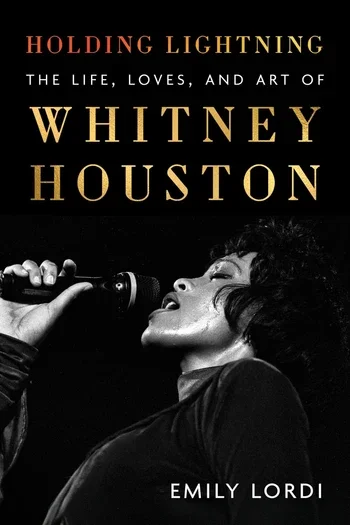
Author Emily Lordi’s study discusses Whitney Houston unique musicality and industry influence.
Over time she gradually ironed out the bulk of these critical and perceptual concerns. Recording soundtracks (e.g., The Bodyguard) expanded the range and context of her repertoire, collaborating with respected producers, like L.A. Reid and Babyface, updated her sound, and the gradual infiltration of hip-hop into pop music gave her late 1990s music an edgier sound. Her vocal talent, sales, awards, and adaptability alloyed into a relative consensus that she was both a genuine talent and possibly a genius.
I was reminded of this reading the comments posted below the New York Times recent review of Holding Lightning, an academic study of Houston’s career, written by scholar and cultural critic Emily Lordi.
The comments were most notable for raising questions about how we understand geniuses when discussing popular music. For every comment attempting to confine the term to singing composers and instrumentalists there were counterarguments which viewed vocal interpretive excellence as equally valid for praise.
The other strand was barbed comments negating the late singer’s consideration for genius based on her publicly documented struggles with drug addiction. In the early 2000s Houston’s canonical status began to fall out of favor when her newfound “edge” went too far. While many people long questioned her attraction to ex-husband Bobby Brown, who had become more famous for crime and infidelity than his once thriving career, the public toll of drug use on her behavior and well-being became most concerning. Suddenly the stalwart crooner was reduced to sassy memes and videos of her struggling to sing making her a punchline. No one was laughing when she died, however.
The latter context partially explains the impetus for Lordi’s study, and Gerrick Kennedy’s exemplary 2022 study of Houston, Didn’t We Almost Have It All. Lordi and Kennedy identify as fans upfront and frame their books as correctives. Kennedy’s book is subtitled In Defense of Whitney Houston. Instead of posing as disinterested observers, they stake their claim as authors and fans in different modes. He as a journalist and Lordi as an academician who writes for broad audiences. The result, in Lordi’s case, is a welcome blurring of scholarship and cultural criticism that reiterates why Houston is a compelling figure.
In the early 2000s, the talent, discipline, and ambition required to achieve her first decade or so of success gradually came undone in the eyes of the public. Missed talk show appearances and concerts, citations for drug possession, a combative marriage to Brown, and gaffes like Faith Hill replacing Houston at the 2000 Oscars ceremony disrupted Houston’s previously pristine image. She appeared more vulnerable and human than ever but also more troubled. Her gaunt appearance at the 2001 Michael Jackson tribute concert and infamous 2002 interview with Diane Sawyer added to this looming sense of precarity. A decade later, after domestic struggles, a short-lived recording comeback, a disastrous tour, and her role in a remake of Sparkle, Houston died.
Since her death we’ve witnessed tiers of posthumous artifacts. First, was the predictable slew of rushed hack “biographies” and amateur web-based “documentaries” that cobbled together secondary and tertiary information. Second, were the books written by Houston’s family, friends, and confidantes who had a firsthand view of her life and career. Many of these voices appeared in the two most well-regarded documentaries Whitney: Can I Be Me, directed by Nick Bloomfield and Rudi Dolezal, and Kevin Macdonald’s Whitney which provided fresh footage and montages of images and sounds placing her career in context.
The third tier, comprised of serious studies, like Kennedy and Lordi’s, are written from a place of love and inquiry, and aspire to offer authoritative critical accounts of her career and the place of Black women in the popular music pantheon. By design, these studies posit Houston as a significant artist worth studying in the same vein as peers like Michael Jackson and Prince who have garnered serious academic attention.
The question Lordi’s book must address is what makes Houston notable for academic inquiry?
Whereas Kennedy’s defense focused on the sacrifices Black artists have made to “represent” the race in their bid for crossover success Lordi’s is an argument about Houston’s underrated prowess. Lordi convincingly illustrates Houston as a musical sophisticate with a deep knowledge of diverse musical references and performances and access to technique that allowed her to elevate her material. Alongside her recordings she cites key live performances, including Houston’s 1986 and 1989 Grammy Awards performances, 1991’s Welcome Home Heroes Concert special and 1991’s “Star Spangled Banner” performance as proof of her transcendent vocal mettle. Later career recordings moments such as her less guarded, more lived in performance on “Why Does it Hurt So Bad” (from Waiting to Exhale) and her credible hip-hop-soul performances on 1998’s My Love is Your Love also represent her argument.
Lordi also depicts Houston as an important trailblazer in music and Black media representation. She recounts how Houston warmed up to Brandy who had long idolized her and later cast her as lead in the pioneering multicultural version of Cinderella on ABC. Lordi also cites other singers including the various women featured on the Waiting to Exhale soundtrack, Monica, Faith Evans, Lauryn Hill and her Sparkle co-star Jordin Sparks as inheritors of Houston’s legacy. Similarly, Lordi cites the importance of Houston shifting from singing exclusively to acting in The Bodyguard, the first major mainstream film with such an interracial love story between and Black woman and White man. Houston’s executive producing of The Bodyguard and Preacher’s Wife soundtracks, and films like Cinderella and Sparkle also reflected broader creative input than is usually credited to Houston.
Lordi wonders why Houston declined to write more of her material, especially after she had established herself, and speculates on Houston’s potential as a producer and mentor for other singers especially as her recordings became more sporadic.
The theme of unfulfilled potential looms even amid the book’s primary focus as an appraisal. What Lordi’s book reiterates from several prior books and documentaries is something hard to shake. Notably, the most consistent aspect of Houston’s singing career was her reliance on recreational drugs. I
raise this less for tawdry purposes than to illustrate Houston’s complicated relationship with her voice. Even at her purest and most powerful moments in the 1980s and early 1990s she was a regular drug user and cigarette smoker. She had enough voice and technique to transcend much of the physical toll of these behaviors, but they gradually caught up with her. While developing a life and interests off the stage can add depth to a singer’s interpretive approach, often signified by a kind of graininess or patina, there is a difference between a twinge of texture and a lack of voice. As Lordi maps out though singing was Houston’s “job” long spells of time passed between her recordings. Her mentor and label chief Clive Davis, who was never shy about his commercial interests, wrote her letters about her lack of productivity which Lordi cites. Whether he knew what she was struggling with is less important than the pressure on Houston to be a commodity.
Lordi recounts the exponential increase in the number of tour dates she took on between her first few albums, and her 1990s era tours. The intensity of Houston’s repertoire understandably taxed her body and voice, and it seems evident that drugs, and the various hangers-on in her traveling entourage, were her respite. Between the end of the My Love is Your Love World tour and the Nothing but Love World Tour supporting 2009’s I Look to You album, Houston barely recorded and delved more deeply into addiction. Though she had stints in rehab and eventually ended her tumultuous marriage to Brown, the glue that held her together, such as her friendship with Robyn Crawford, who ended their working relationship in the early 2000s due to the chaos, was gone.
For the first time, Houston was on her own and the I Look to You tour, which many advised against, made the grim reality of her choices real. Her voice was ravaged and she lacked the stamina to revisit her triumphant vocal moments from the past—the ones that made her a genius. After the poorly reviewed tour ended Houston was able to throw herself into Sparkle but once filming ended, she was alone and succumbed to her familiar companion drugs.
Lordi’s book persuasively argues for Houston’s unique artistry, the generosity of her mentoring, and her importance as a Black woman multimedia pioneer. Yet additional questions remain. For example, if Houston had taken up songwriting what would have been her focus? It’s unclear what her frames of reference were beyond the music industry she was largely raised in. While we know she was an avowed woman of faith and was close to her family, we rarely learn about her interests beyond that. What did she like to read? Was she able to soak up historic sites during her tours? Did she consider herself politically engaged? Beyond the strength of her instrument, which was accessible to audiences during her peak years, we never get access to her point of view. I would love to know more about what Lordi imagines Houston would have written about and in what styles.
The book also reveals some of the challenges of appraisals. Though Lordi is a trustworthy narrator, and is mercifully non-judgmental about Houston’s life, she tends to dance around the decline of Houston’s voice as a result of decades of drug abuse rather than a conscious choice to sound more relatable.
There’s also little genuine criticism of Houston’s repertoire. Even Lordi acknowledges how many of her early ballad performances were as much about the voice as they were about the lyrics. While these made for potent performances there was clearly a physical toll when they had to be performed night after night. Why did Houston rely so much on large scale Michael Masser ballads instead of more intimate, nuanced, and singable material? One can only imagine how her vocal and interpretive instincts might have melded if she sang songs written by Brenda Russell, Valerie Simpson, or Angela Winbush, to name a few vibrant Black women songwriters with records of “hits.”
These questions never arise in the book and are of course conjectural. We’ll never have answers to them. They point to the melancholic sense I got after completing the book. Even 14 years after her passing, we’re still experimenting with all the Voice could have or would have done because we still care about Houston—including what she achieved as an artist and the clarity she might have found as a human being.
COPYRIGHT © 2026 VINCENT L. STEPHENS. ALL RIGHTS RESERVED.