Beyond comedy OR drama: The many registers of John Early’s Maddie’s Secret
In an effusive comment on pop luminary Barbra Streisand pianist Glenn Gould appraised her voice as an “instrument of infinite diversity and timbral resource.” This notion of timbral richness resonated in my head after watching actor-comedian John Early’s directorial debut Maddie’s Secret. Early has mastered a vast range of mostly comedic, and occasional dramatic, registers across mediums as varied as stand-up comedy (John Early: Now More Than Ever), sitcoms (The Comeback), films (Stress Positions), Broadway (What We Did Before Our Moth Days) and memorable late-night talk show appearances, where his collaborations with Aidy Bryant and Kate Berlant verge on performance art. Over about 15 years he has authored a style defined by a refreshing willingness to take risks and experiment by embodying characters whose persona routinely disrupt expectations in an era of “frictionless” entertainment. You cannot ignore him and that is a unique strength.

A genre-defying project like Maddie’s Secret is so dependent on tonality that a writer-director must possess an almost impossible combination of obsession, knowledge, meticulousness, nuance, and vision—and Early’s got the goods. In short, they must be a master of tone. Maddie’s re-imagines the familiar conventions of earnest, TV movies of the 1980s (such as 1986’s Kate’s Secret starring Meredith Baxter Birney; viewable on YouTube), by viewing TV melodrama as a genre that can co-exist with the sincerity of 1950s “women’s pictures”, the ironic sensibility of contemporary comedy, and elements of camp without feeling like a parody. Like objects of camp affection, Early must love and understand TV movies to nod to them emotionally. The earnest, aspirational topicality of the genre must intrigue Early to some extent given the serious nature of the film’s secret. He simultaneously needs enough critical distance to understand their narrative mechanics and aesthetics and offer an audience something new.
Whereas camp can sometimes border on condescension and mockery Early, who dons a wig and prosthetics to portray the lead character, plays Maddie straight. She goes from being a dishwasher at the food “content” website, Gourmaybe, to the site’s leading “recipe developer” (e.g., on-air cook) thanks to a video her devoted husband Jake (Eric Rahill) films and posts, which goes viral. As she rises through the ranks, she remains a modest, sincere, self-effacing presence whose innocence endears her to admirers like co-worker Deena, played hilariously and lustfully by Berlant, and enemies like the insecure rival chef Emily (Claudia O’Doherty). Early on the film shows, her mother, Beverlee, played with searingly by Kristen Johnson, as a potentially toxic presence as well.
After breezing through Maddie’s gradual rise through a seamless montage of videos her ascent reaches a dramatic turn when a restaurant themed TV series (The Boar a winking riff on The Bear) seeks a new culinary consultant. Suddenly competing with Emily for the gig Maddie’s bulimic episodes and her internal pressure to feel sufficiently thin and attractive escalate. Instead of exploiting her struggle the film shows us just enough to understand giving her struggle the dignity it deserves. Maddie’s effort to manage her anxieties comes in the form of a queer-themed dance class Deena introduces to Maddie. Unsurprisingly her extreme behavior catches up with her during a frenetic sequence where she grows increasingly exhausted and eventually collapses.
Her enrollment in an in-patient treatment program managed by the compassionate Dr. Kronenfield (Chris Bauer) places Maddie is a very different emotional setting than the toxicity of her competitive workplace or the easy access her household provides for obfuscation. Instead, her new environment requires her to adhere to new rules, sacrifice control and get to the root of her disorder. Here the film reaches its creative acme feeling more like a kind of tone poem than a commentary on bulimia. Maddie interacts with the center’s eclectic gang of characters, who range from a group of insecure mean girls to Maddie’s childlike roommate Julie (Vanessa Bayer), in a predictably friendly manner even when she is rebuffed. Yet in group therapy sessions we get more hints about all she is suppressing beneath her perky facade.
In a conventional film these interactions could lapse into relentless earnestness yet the film leavens things through the colorful center staff, and a surprising new patient. Maddie’s attempt to remain viable for The Boar competition inspires a poorly conceived escape that only worsens her mental state. Returning to the center she and Dr. Kronenfield finally persuade Beverlee to attend a therapy session. Inappropriate and lacking in empathy, but periodically funny, Johnson’s wryness generates uneasy comedic and dramatic tension which forces Maddie to unpack her baggage further.
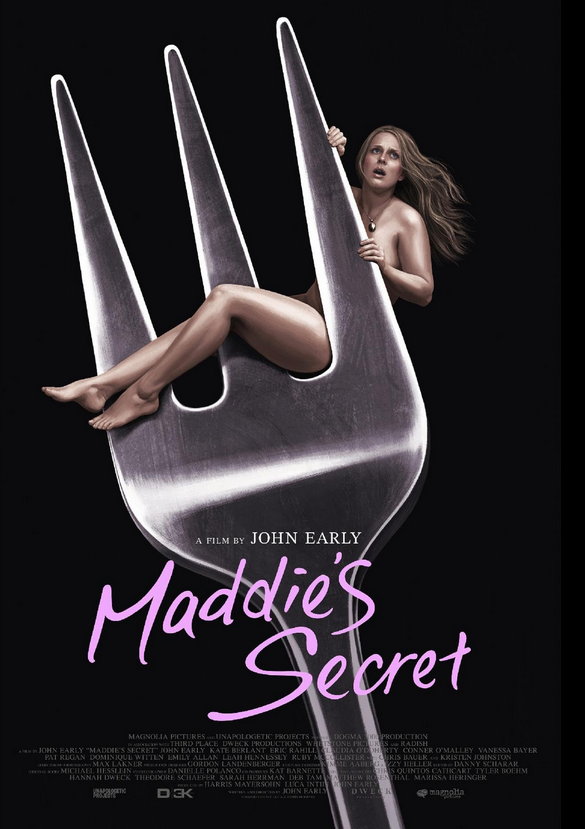
Just as TV movies must come to an end to make room for the evening news, the film must wrap things up. Staying true to its stylistic inspiration things seem to get back on track for Maddie—she’s released from treatment and reunites with the long-suffering Jake. Yet despite all the cues telling us things are over fears of Maddie relapsing and questions about trust linger.
The final scene’s setting, action, filming, and score employs the pat signifiers of movie-of-the-week triumph yet leaves us feeling ambiguous in a tragicomic way. We know her release is just one stage of a longer process, but melodramas need us to pretend otherwise; Maddie’s Secret understands this and the note it ends on speaks volumes about its respect for its audience. We recognize what these kinds of stories must do stylistically knowing they are inadequate emotionally.
COPYRIGHT © 2026 VINCENT L. STEPHENS. ALL RIGHTS RESERVED.