2025-26-ish Raves & Faves: The Best Popular Culture (later 2025 edition)
2025 is behind us and the requisite “Best Of” lists that end the year annually urge us to catch up on what we might have missed or remember what was good. In August I headed off the rush by publishing three posts on the TV shows, popular music, films, books, museum exhibits, and video/podcasts I was enjoying most check it out here: (Catching up with The Culture Part 1: What’s Worth Watching on TV — Riffs, Beats, & Codas).
Five months later I have more to add to the lists, but what interests me most is less about anchoring us in 2025 than considering what cultural moments have the greatest potential to linger into 2026. The best popular culture summons our attention well after critical buzz and discursive repetition has drawn us in, excited us, numbed us, and led us to our next temporary obsession. The most remarkable culture I encountered inspired me to carry it with me rather than consume, discard, and move on to something else.
*********************************************************************************************
FICTION
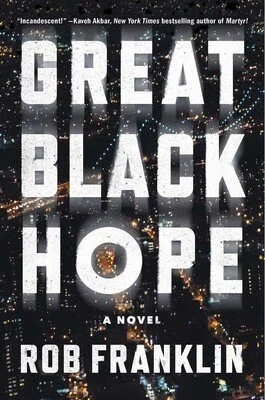
Great Black Hope (by Rob Franklin, Summit Books)
The most enduring fiction I read in 2025 is Rob Franklin’s debut Great Black Hope. It’s an engrossing novel that reminded me of the excitement I felt reading recent debut novels and short story collections by Jonathan Escoffery, Deesha Philyaw, and Alejandro Varela. Great initially begins with a kind of fish-out-of-water story in the sense that Smith is a college educated Black man from an upper middle class academic family in Atlanta who makes a minor drug transaction in the Hamptons and is then booked and arrested and quickly released. We learn that in college he has befriended Elle, the daughter of a very well-known Black R&B singer from the 80s and 90s as well as Carolyn a White socialite who is almost oblivious to her wealth, privilege, and social mobility. At the outset of the novel as he and his family figure out the best lawyer to hire so he can navigate his upcoming court date we think how naïve he must be to not realize that as a Black man he's standing out in the Hamptons. No matter how educated and fluent he is in the cultural norms of that space he still sticks out.
As we spend more time with him, we see the world through his eyes including the kind of games he must play for the local judiciary to demonstrate that he is aware of his “crime” and willing to rehabilitate himself. We also find that while his social life is disrupted by having to enroll and rehab and verify that he is walking a new and so-called sober path, he also begins to question his professional world. Smith works at a company that acquires art and has an interesting visit to accumulate art. His boss brings him along largely because he is Black and she is working with a hip up-and-coming Black artist named “O” who rejects the company's attempt to purchase her work as a form of protest. Alas, his boss turns on him accusing him of underperforming for failing to help seal the deal. Disenchanted, he wonders what he's doing in New York and goes home.
The Atlanta scenes are where the novel distinguishes itself given how rarely we read a novel where a Black writer articulates nuances of a certain kind of Southern upper middle-class existence. Based on his complex interactions with his family, including his grandmother, an esteemed attorney, and his father an academician, we witness internal pressures to adhere to a certain kind of respectability politics. And at the same time, he also rebels in his quiet way by refusing to completely short circuit his life in New York for the presumed calm and stability of home. Great Black Hope immerses you in some very tense moments especially with his grandmother who's accumulated property and expects him to abandon his New York life and take over. We see him struggle to assert that while he is struggling to make sense of his life in New York, he's not particularly interested in compromising his independence so he can fall into line and fit with certain familial expectations. He is simultaneously navigating an additional challenge of making sense of Elle’s murder and the speculation surrounding the circumstances. He gradually realizes that the rhetoric surrounding her death is infused with presumption whereas when Carolyn makes a variety of social faux pas there are few consequences; these are merely features of her lifestyle.
He returns to New York and after a series of interactions with Carolyn he realizes that he can, and should, re-evaluate his life and his friends. He ends up running into a friend of O and connects to a new space comprised of Black artists and activists who offer him a kind of third space outside New York’s White socialite world and the Southern Black respectability politics he grew up with. He begins to understand what's possible in a new way and it's a revelation for him and for us. To call Great Black Hope a coming-of-age novel is to reduce it to a cliché. When we encounter Smith, he's already come of age; he's completed his formal education and is gainfully employed and socially active. It's more of a coming-to-consciousness more than anything else because he begins to realize that there are aspects of the urban elite White world that have shaped him and as have aspects of Black upper-middle-class life. His work is to synthesize them in his own way to figure out who he is or could be. It's a story I cannot quite recall any other novelist telling, certainly not in the 21st century, and I finished the novel feeling like Franklin tapped into something unique that offers us a new door for further exploration. When I finished the novel, I wanted to know where this character was going and who he was becoming.
Literary discoveries and rediscoveries:
Even though reading is my passion and I constantly pretend that I'm not going to purchase more books until I finish the books I already own, I found myself revisiting the past and playing a game of catch up rather than focusing so much on new accumulations. As such, this past year in reading was about catching up with novels that have sat on my shelves for a time and revisiting previous favorites.
Less: A Novel (2017) and Less is Lost (by Andrew Sean Greer, Boudreaux Books, 2022)
I remember learning about the 2015 Pulitzer Prize winning novel Less and being curious and so during a trip abroad in Brazil I started reading it. It's an interesting novel about a kind of middling writer who constantly finds himself on panels for literary prizes and makes appearances at literary festivals and we can't quite figure out, and he can't quite figure out where he places in the contemporary literary world. We learn that he is a protégé and former lover of a successful and pretentious older writer and has basically been absorbed into that older writer's life for a long time. After they break up, he is adrift and is trying to figure out who he is and so Less is a kind of travelogue where he is bouncing from place to place feeling a bit displaced but also figuring out kind of where he fits into the larger world. It's a kind of middle age coming-of-age if you will and I found the original interesting enough that I instantly poured into the sequel Less is Lost to further explore this journey he takes that leads him all over the United States. Whereas the first novel places him feeling somewhat adrift in Europe and Asia in Less is Lost he has a reckoning with his own background including kind of where he grew up and his troubled relationship with his father and while it's not as surprising as Less it's still funny and touching and exploratory in its own way so I enjoyed following him on a new journey.
If I Had Two Wings (Randall Kenan, Melville House Publishing, 2020)
The great Randall Kenan wrote a classic in 1989 called A Visitation of Spirits focused on a Black queer man making sense of himself in a racist and homophobic world. Kenan’s 2020 short story collection If I Had Two Wings published shortly after he died is a genuinely eclectic and engaging collection. I really enjoyed the various scenarios he presents ranging from a man who Billy Idol bumps into and invites to play guitar on stage even though this man is ostensibly not a musician through a couple trying to navigate their relationship. The prose is eloquent, the characters are colorful and the situations he presents were refreshing in range and texture.
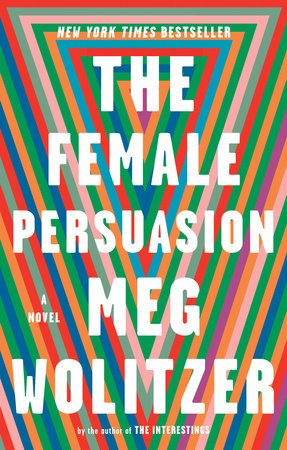
The Interestings and The Female Persuasion (by Meg Wolitzer, Riverhead Books, 2013; 2018)
Meg Wolitzer's 2013 novel The Interestings is a great example of a book whose critical responses fundamentally make you curious. I remember reading several reviews before purchasing the novel and reading it while on vacation and consuming it voraciously. I lent the hardback version of the novel to a friend, and it was never returned. Realizing this I found the paperback version on sale and decided to reread it. The novel chronicles the adult lives of an eclectic group of artistic kids who attended an arts camp in upstate New York the mid-1970s for years and pursued divergent paths. Their intricate bond is rocked by a scandal between two members of the group, that soon becomes a criminal matter and family secret. A formerly promising folk music prodigy in the group gives up music in response to the lingering trauma of an adult’s exploitation of his compositional talent. Another member of the group, who felt like an outsider before being welcomed in the camp group, gives up the arts. She and her husband live out the tension between their working-class life in New York and the affluence and fame of a couple within the group. It’s an intricately rendered story of well-drawn characters navigating complex situations in their families and careers. Wolitzer’s fluid ability to transport us in and out of time is impeccable because it is done so elegantly and so deftly; we feel these characters as living breathing beings whose instincts and responses feel very natural and credible because she's given us such a strong foundation from the outset.
A few years after The Interestings Wolitzer was interviewed by the New York Times and discussed how women's literary fiction is often segregated and marketed narrowly whereas men’s literary fiction is often praised effusively and presented as universal. The article paralleled the release of The Female Persuasion (2018) an equally accomplished novel about growing up only instead of tracing multiple decades in its characters’ lives she focuses on ways we are often forced to mature between late adolescence and our the mid-20s. Central to the novel is Greer, an enterprising but idealistic young woman, whose idol, a famous feminist writer and activist, Faith Frank, speaks at her college and electrifies her to serve. Greer was admitted to Yale but her flaky parents screwed up her financial aid materials so one gets the impression she is destined for something more advanced than the feeble surrounding of her middling state university. She makes new friends in college, and continues dating her high school boyfriend, Cory, who attends Yale and is on track to become a successful consultant. Greer maximizes her time and reconnects with Frank who hires her to work for a new feminist themed venture in New York funded by a well-known corporate investor. Despite her unease in the corporate environment, she is steadfast in her support of the organization’s work but becomes increasingly skeptical of the enterprise. The Female Persuasion focuses on characters who refocus their lives out of necessity. Their gains rarely come to them without some compromises, and a variety of circumstances forces them to grow up and understand the contours of their lives beyond the highly controlled, tightly wound paths we often forge in our youth to survive.
MUSIC
My favorite music of 2024, including popular music by Beyonce, Brittany Howard, Britney Spencer, and Chappell Roan, was some of the best of the decade so far. I found the pop music of 2025 more redundant and predictable. The mostly jazz oriented music I cited in August, including Dee Dee Bridgewater and Bill Charlap’s riveting voice and piano set Elemental, and Holly Cole’s refreshingly diversified No Moon at All remain the best music I heard last year.
2025-early 2026 has also been a period of loss. Some of popular music’s most enduring musicians died including D’Angelo, Roberta Flack, Sheila Jordan, Becky Kilgore, Cleo Laine, and Brian Wilson died. Further, several of its most vital artists including blues vocalist and pianist Marcia Ball and jazz artists Diane Schuur have had to retreat from performing and recording due to health challenges.
Despite these challenges 2026 is brimming with promise. I’m excited by forthcoming new music by the great Jill Scott who hasn’t released an album in over a decade, and Dianne Reeves. I recently attended a superlative performance at Berklee by her and her band. Based on her superlative interpretations of “What’s New” and “Our Love is Here to Stay” I’m excited for her recently completed an album of duets with guitarist Romero Lubambo.
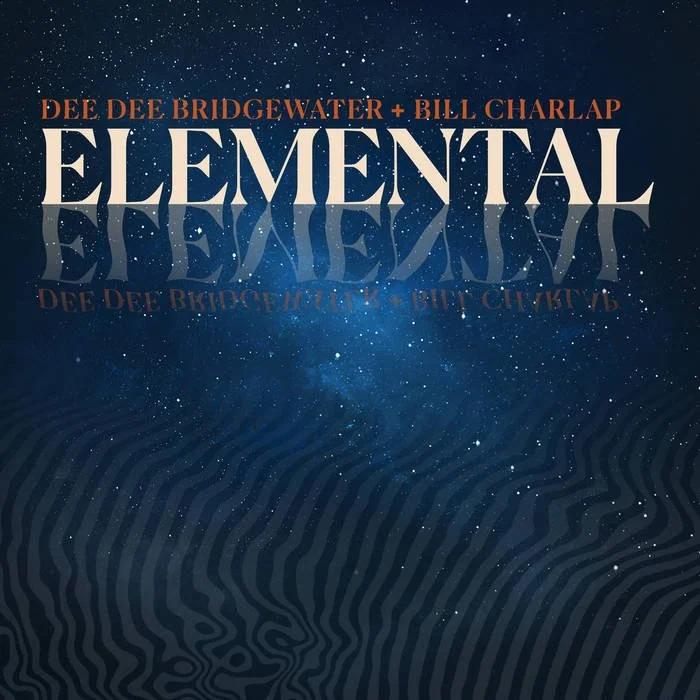
Outstanding Albums:
Dark Moon (Holly Cole)
Elemental (Dee Dee Bridgewater and Bill Charlap)
Here for it All (Mariah Carey)
Raíces (Gloria Estefan)
Thee Black Boltz (Tunde Adebimpe)
Notable Musician Deaths (2025-26):
Roy Ayers
Alan Bergman
Jerry Butler
Jimmy Cliff
D’Angelo
Marianne Faithfull

Roberta Flack (1937-2025): Growing up my mother loved the elegant sound of Roberta Flack’s voice. She made pretty, beautiful music in the 1970s and it sounded even more so during the 1980s, when I was growing up, a time when music was perceived as coarser and more commercial. In truth every generation fights with emerging music of the next. Flack shared with Karen Carpenter, another maternal favorite, a kind of vocal serenity and purity. Whether the ballads were meditative (“The First time Ever I Saw Your Face”), sweeping (“Killing Me Softly with His Song”), or breezy (“Feel Like Makin’ Love”) they were distinctly hers. While she could sing up-tempo material credibly her ballads transcend the trendy nature of dance pop and continue to provide a blueprint for her fellow artists. My most personal moment with Ms. Flack’s music came in the late 1990s when I purchased her 1977 album Blue Lights in the Basement. Though its best known for her dreamy duet with Donny Hathaway “The Closer I Get to You” the set showed me less stately aspects of Flack’s artistry. “After You” has a dewy vulnerability; on “I’d Like to be Baby to You” recorded live (you can hear applause after a thrilling solo) she flexes a sultry jazziness; Rolling Stone’s original review pointed out the almost trashy sentiment of “Why Don’t You Move in With Me” and it’s true. Flack sounds more relaxed than ever and no less musical. Albums were rarer for her from the 1980s onward. The most notable is 1988’s Oasis led by the effervescent Caribbean flavored title song a #1 R&B hit that somehow failed to become a “pop” hit. Buried within its sleek, electronic production, are some of her best songs including the brilliantly romantic “You Know What It’s Like.” I was sad to hear she was stifled by a stroke a few years ago and even sadder she passed yet encouraged by her multigenerational appeal. Luther Vandross, Alison Moyet, Lauryn Hill, George Michael, D’Angelo, and others have revisited her catalog and kept her in rotation.
Connie Francis
Garth Hudson (The Band)
Chris Jasper (Isley Brothers)
David Johansen

Sheila Jordan (1925-2028): Discovering Sheila Jordan was a milestone in my budding love for vocal jazz in the early 2000s. A friend and co-worker who’s now a music educator turned me on to some post-bop singers including Mark Murhpy, Jordon, and their protégé Kurt Elling. Where singers like Ella and Sarah hypnotize you by the sheer beauty of their voices Jordan’s appeal is far less obvious. Her strengths are more rhythmic and tonal; small voiced and radiant she was an original. Born into hardscrabble circumstances she has recounted how jazz music, especially the bebop of Charlie “Bird” Parker, not only entertained her but saved her. Inspired by bop she became part of the Detroit jazz scene at a time when White women socializing with Black men was a social taboo that exposed her to racism. Undeterred and unwilling to give up her love of jazz she eventually moved to New York in the early 1950s to study jazz and make her living as a singer. Her 1962 debut Portrait of Sheila was a completely original vocal approach in its sparseness and subtlety. As the culmination of years of performing and studying it instantly set her apart in her repertoire and approach. In the 1970s she was one of the first jazz vocalists to lead jazz clinics and camps for aspiring singers. She also pioneered the voice-and-bass format employing her voice as a melodic and harmonic instrument in concert with esteemed bassists Arild Andersen, Harvie Swartz and Cameron Brown. In the early 2000s, when CDs remained cutting edge, I was overjoyed when I stumbled upon remastered Jordan albums I assumed were long out-of-print including 1975’s Confirmation, 1977’s Sheila, and 1986’s The Crossing. Jordan recorded acclaimed, exploratory albums on independent record labels exclusively and had an active career as an educator and performer well into her early 90s. When I listen to her, she is not just singing, she is living and breathing through the music. Listening to her feels like a secret I want discovered. Her original composition “Sheila’s Blues” is a dynamic song, with everchanging lyrics, where she gives herself space to testify; to tell her story in profoundly personal terms. In 2012 the National Endowment for the Arts (NEA) recognized her as Jazz Master. I’m sure she relished the honor, but it seemed like they were finally catching up to her; she had already given jazz so much.
Rebecca Kilgore
Cleo Laine
Wayne Lewis (Atlantic Starr)
Chuck Mangione
Sam Moore
Ozzy Osbourne
Eddie Palmieri
Lalo Schifrin
Walter Scott Jr. (Whispers)
Jeannie Seely
Jill Sobule
Angie Stone
Sly Stone
D’Wayne Wiggins (Tony! Toni! Tone!)
Brian Wilson
Peter Yarrow (Peter Paul & Mary)
Jesse Colin Young (Youngbloods)
FILM & TELEVISION
TELEVISION
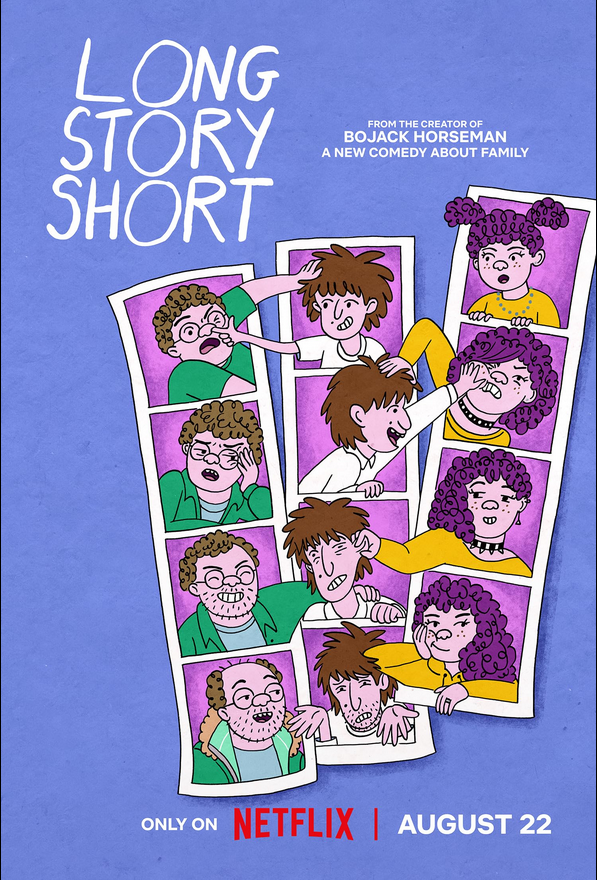
Outstanding TV:
Abbott Elementary
Adolescence
Deaf President Now!
Deli Boys
Dope Thief
Forever
Hacks
Have I Got News for You
Heated Rivalry (read more below)
Long Story Short (read more below)
Paradise
Pee-wee as Himself
Severance
The Bear
The Chair Company
The Righteous Gemstones
The Studio
Individual TV Performances:
Owen Cooper (Adolescence)
Erin Doherty (Adolescence)
Ayo Edibiri (The Bear)
Danny McBride (The Righteous Gemstones)
Hannah Einbinder (Hacks)
Tim Robinson (The Chair Company)
Noah Schapp (Stranger Things)
Connor Storie (Heated Rivalry)
Tramell Tillman (Severance)
Seth Rogen (The Studio)
TV Ensembles:
Abbott Elementary
Adolescence
Hacks
Heated Rivalry
Righteous Gemstones
Severance
Stranger Things
The Studio
Long Story Short: On BoJack Horseman its creator, Raphael Bob-Waksberg, took an improbable premise, even for a cartoon, and made one of the most insightful and affecting dramedies of the 2000s. His penchant for deep characterization, compelling serialized storylines, nuanced interpersonal dynamics, and intricate composition persist in Long Story Short. It engulfed me when it first premiered in late August and rewatching it in December drew me even closer to the world of the Schwoopers, a White, Jewish family comprised of Naomi Schwartz and Elliot Cooper, and their children Avi, Shira, and Yoshi. Unbound by time constraints and linearity the series bounces from the adult Shira and her wife Kendra’s struggles to start their family in the 2000s back to Naomi’s childhood in 1959. Just as every episode’s opening animation varies—pay attention, and you will be rewarded—each episode tells an intricate story and reveals something particular about who these characters are and why they respond so passionately in challenging situations. The collage like narrative structure exposes us to Avi’s effort to relay his Gen X values to his iconoclastic daughter Hannah, Shira’s disappointment in Avi abandoning her in key moments of her childhood and adult life, Yoshi’s struggle to focus, Kendra’s fusion of Type-a intensity with loving tenderness, and Naomi’s overbearing, passive aggressive, yet endearing way with everyone, are lingering examples of how the animated series makes its characters life-like. Regardless of the viewer’s specific cultural background the relational dynamics are palpable. When tensions arise, we understand where they originate and how they could play out because we are so immersed and invested. I am excited to see how its blend of chaos, drama, and love will advance in future seasons.
Heated Rivalry: Great television does not necessarily have to conform to “prestige” television conventions. Watchability and sex appeal are old fashioned television virtues that can be just as compelling as the high concepts, metacommentary, and cinematically inspired aesthetics we tend to laud in scripted television. Despite the aggressive social media promotion of Heated Rivalry, a pulpy series centered on closeted male hockey players based on Rachel Reid’s pop novel series, few were prepared for how delightfully ribald, and unapologetically juicy the series is, or how it envelopes you. At the outset the unspoken tensions between the benign, nearly anodyne Canadian hockey star Shane Hollander and the intensely jocular Russian player Ilya Rozanov, will inevitably escalate and, thanks to surefooted direction and a lean script, they come together with great humor and considerable heat. After the steamy first few episodes we delve into more emotional territory via a tense storyline between a closeted hockey player and an “out” gay man, and the increasing ambiguity about the status of Shane and Ilya’s relationship especially as they gain greater fame. Soapy, sexy, and playful I plan to rewatch it in preparation for its next season.
Friendship and The Chair Company: Before he refined his slow burn, highly combustible cringe-comedy style on I Think You Should Leave, and extended its scope in the film Friendship, and the series The Chair Company Tim Robinson was relatively invisible on Saturday Night Live (2012-16). While he may not have created any signature characters or catchphrases there, over time he has fused physically awkward, emotionally unstable, and socially confused behavior into a distinctive mode of comedic and dramatic expression. Friendship provides the most elaborate narrative showcase for a comedic style whose intensity is defined by escalations that must eventually diffuse. In the film his character Craig Waterman is so eager to befriend his neighbor Austin (a delightfully smug Paul Rudd) and fit in with his group of male friends, he routinely miscalculates emotional boundaries alienating all parties. His desperation to feel vital leads him to take a series of stupid risks, such as buying drugs and breaking into a home, that gradually lead him to unravel. The tenson between comedy and danger, and naivete and aggression also inform Robinson’s lead role in The Chair Company, as Ron Trosper a mall developer whose accidental pratfall in a chair at a corporate event leads him down a rabbit hole of revenge to learn more about the chair’s manufacturer that spirals into a ridiculous sprawl of possible leads, conspiracies, and near-misses. Ron, like Craig, harbors a sense of possibility shadowed by a darkness and intensity that can emerge aggressively and sporadically and isolate him. While his family navigates their own challenges mostly in the background, he has multiple clandestine encounters with oddball characters and strange situations that point him in variety of directions. Whether Ron solves the mystery of the chair becomes increasingly less relevant than the experience we are provided in this unusual caper which will return for a second season.
FILM

Outstanding Films:
Friendship (see above)
Hedda
Heightened Scrutiny
One Battle After Another (see below)
One of Them Days
Peter Hujar’s Day
The Secret Agent (see below)
Sinners
Twinless
Individual Film Performances:
Will Arnett (Is This Thing On?)
Jesse Buckley (Hamnet)
Nina Hoss (Hedda)
Dwayne Johnson (Smashing Machine)
Michael B. Jordan (Sinners)
Tânia Maria (The Secret Agent)
Wagner Moura (The Secret Agent)
Dylan O’Brien (Twinless)
Tim Robinson (Friendship)
Paul Rudd (Friendship)
Teyana Taylor (One Battle After Another)
Tessa Thompson (Hedda)
Ben Whishaw (Peter Hujar’s Day)
Ensemble Performances:
Hamnet
One Battle After Another
Sinners
One Battle After Another: After years of writing and directing (accomplished) films that fit comfortably into perceptions of prestige films (e.g., Magnolia, There Will Be Blood), Paul Thomas Anderson’s movies became more outré, and even more personal. Pivoting from the indie director-on-the-rise to more of an auteur found him honing his art while losing some of his audience. The Master enchanted me, I couldn’t get through Inherent Vice and had no interest in Licorice Pizza yet I was intrigued by One Battle After Another based on the trailer. What was he cooking up for us now? In this loose adaptation of Thomas Pynchon’s Vineland, we follow the fate of revolutionaries, both active and inactive, on the hunt from a rapacious government determined to silence dissent and close the circle on crimes of the past. When the film begins, we see the efforts of an anarchist group, French 75, led by Perfidia (Teyana Taylor), Deandra (Regina Hall), and Pat (Leonardo DiCaprio), among others, to free migrants from detention centers. Their adversary is a racist, daft Colonel Lockjaw (Sean Penn) determined to capture them. After Perfidia is captured after a bank robbery she becomes an informant under witness protection then disappears; meanwhile, several members are captured or killed. Left behind is Pat and their baby daughter Charlene who move to the pacific northwest under assumed names Bob and Willa. After decades of quiet civilian life in California Lockjaw seeks them out with a mission to capture and kill Willa. After placing us in the center of the group the pace abruptly slows us to view the post-revolutionary life of Bob, now a burnt-out stoner and Willa, a typically rebellious teen The film accelerates from a fast-paced expository depiction of the group to the abrupt transition in Bob and Willa’s life which culminates in Lockjaw’s relentless hunt for Willa who he seeks to kill and capture to vindicate himself for membership in an elite White supremacist secret society. The film grips you with unusual tenacity employing humor, slapstick, car chases and a spectrum of dark humor as it races to its conclusion. It’s a most thrilling journey and its artful construction is a master class in narrative excitement.
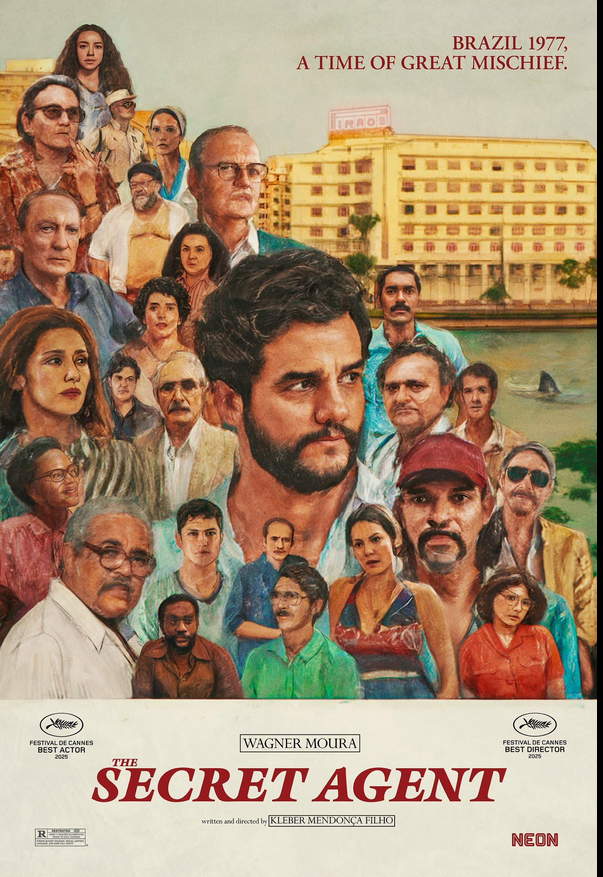
The Secret Agent: Director and screenwriter Kleber Mendonça Filho places us the center of the rippling currents of the dictatorship in Brazil in this narrative film set in 1977. The radiant Wagner Moura travels to Recife under an alias (“Armando”) so he can reunite with his son. He is quietly welcomed into a secret community of political exiles shepherded by the incredibly charming and wryly funny Dona (Tânia Maria) who helps him and other others fleeing persecution make a life for themselves under challenging circumstances. Along with reuniting with his son Armando gets a job, finds companionship, tries to reinvent himself and is confronted by the aggressive campaign to assassinate him. The film juxtaposes the covert and overt terrors of fascism 1977 with a contemporary effort by two researchers to understand what happened while Armando was under siege. The resulting film is remarkably intimate and engaging and provides us with a bird’s eye view of the latent fear, anxiety, and paranoia people experience trying to live as normal life as possible under oppressive regimes. Delving deeper into the back story of Armando’s situation illuminates the way authoritarian power haunts and terrorizes even the bravest of us. Moura gives a star making turn and Mendonça Filho emerges as one of the most viral storytellers of our time. I attended a local screening of the film followed by a question-and-answer session with the filmmaker who acknowledged the film's parallels to the rise of Bolsanaro’s dictatorship in 2019. The film artfully renders how vigilance is essential to ensure these regimes never happen again, making the film an incisive fictionalized account of the events of the late 1970s as well as an admonition to remain for the 21st century. The Secret Agent reminds us we have not escaped the forces of fascism.
COPYRIGHT © 2026 VINCENT L. STEPHENS. ALL RIGHTS RESERVED.