Getting critical about music critics: The Last Critic review
The Last Critic (2026)
Matty Wishnow, director
The title of Jessica Hopper’s 2015 essay collection, The First Collection of Criticism By A Living Female Rock Critic, speaks volumes about rock criticism’s insularity. Aside from Ellen Willis (1941-2006) women had less opportunity than men to publish rock criticism during the analog era and less influence shaping rock’s critical canon. This caveat also applies to writers of color. In director Matty Wishnow’s new documentary The Last Critic, which adoringly profiles the career and life of music critic Robert Christgau, Hopper speaks frequently as do several critics from diverse backgrounds (e.g., Ann Powers, Greil Marcus, Colson Whitehead). Their presence as talking heads functions as exposition and indicates a less told story about rock criticism which the documentary skirts. Christgau is a blazing symbol of the Golden Age of rock criticism and represents some of the era’s biases and critical limitations.
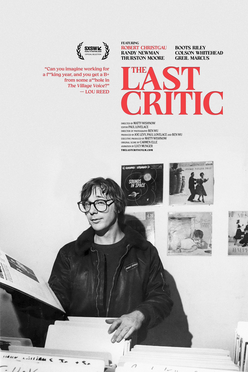
The Last Critic explores the life and career of influential self-appointed “Dean of American Rock Critics” Robert Christgau.
After cutting his teeth as a reporter Christgau found a home as the music editor at the Village Voice. At the Voice he cemented his own critical language style through his weekly “Consumer Guides” which featured his punchy, succinct, and often acerbic, reviews of new music. He estimates that he has reviewed over 17,000 albums in his career, which kicked off around 1967, and he continues to review voraciously in his labyrinth-like home office where CDs, music books, and tapes, surround him on massive shelves. His haiku-like sentences pepper the documentary and hit you hardest as they are visualized and read aloud. While you might disagree with his reviews his sense of style is undeniable; he knows what he likes (hip-hop, South African pop), what he loathes (prog rock, “sensitive” 70s era male singer-songwriter music, heavy metal), and why. He is clear-eyed without coming across as cocky.
He is also an editor of renown. Some of our most gifted writers, including Nelson George, Gary Giddins, Powers, and the late Greg Tate (1957-2021), comment on his fierce editing style. His pointed invective might have left a few emotional wounds, but their writing clearly improved through his input. Beyond his reviews we meet his sister, see high school photos, learn more about his wife, writer Carola Dibbell, who edits his work, hear from his daughter, and his current editor, Joe Levy, and get a fuller picture of his life.
The film also blends vintage television footage from local and national programs, with current interviews that reveal his consistent persona as a passionate lover of music who sees his writing as a kind of service for consumers. Authenticity is the thread in his writing. Either he buys what you’re doing as a musician, or he doesn’t and he isn’t shy about defending his perspective. While he says most albums have received “B” grades in his grading system the criteria for achieving “E-” grade is hilariously bitchy.
One of the bigger issues the film touches upon is the unique role of the alternative press in U.S. journalism, as well as the current precarity of music criticism. In 2005, after 38 years the new corporate owners of the Voice fired Christgau and other senior editors. Unemployed he rebounded writing for MSN Music, Cuepoint, and Noisey, building a strong online rapport with fans and readers, and eventually launching a popular Substack. One can imagine him typing away on his dated PC with music piping through his family’s home in perpetuity.
The contemporary notion of a music critic sitting in a room surrounded by physical albums typing earnestly to help readers distinguish between the good and bad records seems quaint to the point of absurdity. The audience that once existed for music criticism in magazines like Crawdaddy, Creem, Rolling Stone, and the Voice, and more contemporary derivatives like Spin, and Vibe have dissolved and fragmented. Online sites like Pitchfork still attract readers hungry for critical insights into new music but the era of influential music critics has passed.
The advent of blogging and online newsletters, as well as comments sections, has made everyone a “critic” no longer subject to peer review. Social media has also galvanized music fans to forge “direct” relationships to their favorite artists that seem “real” though a medium is a filter by default. The result is a rabid fan culture which dismisses all criticism as “hate.” Persona is in, standards are out, so who needs critics, anyway? No matter how knowledgeable or experienced a music critic might be it’s hard to imagine a person tracking down Christgau’s Substack, to read his thoughts on Kendrick Lamar or Taylor Swift.
Christgau, who jokingly appointed himself the Dean of American Rock Critics, is part of a relatively small group of influential critics including Lester Bangs, Jon Landau, Dave Marsh, Greil Marcus, and, to a lesser extent, Willis, who significantly informed the musicians that mattered for several generations through their writing. The Whiteness and maleness of this group is inseparable from the tragicomically unsubtle title of Hopper’s collection. As Robert Draper noted in 1990’s Rolling Stone Magazine: The Uncensored History rock criticism was a mostly straight, White boys club from the late 1960s through the early 1990s. Some of the genre’s most prolific writers, including Marcus and Marsh, parlayed their review writing into writing acclaimed monographs while others lacked similar access in the music publishing field or were celebrated posthumously.
Women were far less welcome in the critical world. The Ellen Willises and Susan Hiwatts (who wrote 1971’s “Cock Rock” on misogyny and patriarchy in rock) were a minority. Racial minorities, usually Black men, were mostly absent or confined to writing about R&B and funk until they were trusted to write about hip-hop in the late 1980s. We see and her from George, Tate, and Whitehead, who wrote for the Voice, as well as Kelefah Sanneh who writes for the New Yorker. Alongside Hopper and Powers, is the New Yorker’s Amanda Pertrusich. Their presence feels like a historical sleight-of-hand that overrepresents the diversity of the field itself. While their comments on Christgau are astute and welcome, none of them had access to major national publications until the late 1980s except for George who wrote for Billboard in the early 1980s. It’s also notable how many of these writers branched into fiction, filmmaking, and other forms of feature writing beyond music criticism. This speaks of the dwindling opportunities and the challenge of making a full-time living as a critic post-Golden Age.
In that regard Christgau truly represents the end of an era. The documentary’s effusive coverage of Christgau illuminates little about his musical knowledge beyond his impressionistic approach. As affecting as his writing can be other writers like Landau, who quit the critic business to manage musicians, notably Bruce Springsteen, and the New York Times’s Jon Pareles are more adept at discussing the music itself. While music criticism is not necessarily better when it’s more technical, much of the critical language of late 1960s-early 1970s rock criticism centered more on persona and sociocultural affiliations than music. This haunts the work of many of the more canonical rock writers who often resorted to cheap shots and ad hominem attacks. Christgau’s Consumer Guide books and the 1979 and 1983 editions of the now defunct Rolling Stone Album Guide are laced with proto-trolling style comments. In this regard classical criticism and jazz criticism, which have their biases as well, have aged better historically.
I also question the simplistic equation of sheer volume of listening with insight. Few people are truly experts in the historical and aesthetic aspects of most musical genres. Just as music critics have questioned how far musical artists can stretch their expressive boundaries credibly—think Elvis Costello singing country music or Linda Ronstadt making a “new wave” album—one wonders if Christgau is an authority on hip-hop and jazz and South African pop and country music and folk music, etc. Is his writing so seductive we’re willing to overlook these kinds of questions? Could so much round-the-clock listening dull one’s ears and narrow one’s taste? While an argument could be made for the unique appeal of a specialized approach Christgau’s populism can make his writing diffuse and exhaustive. The documentary never addresses these thorny issues, preferring a more reverent glow.
Even though the film touches upon the crumbling journalistic infrastructure for critics the issue of who got to be a rock critic during its Golden Age and why it matters remains germane.
For example, one glaring omission from the critical discourse of rock era criticism was the writing of Phyl Garland (1935-2006), a Black woman who wrote for numerous publications most notably for Stereo Review. Her 1969 book The Sound of Soul is a superb history on the enduring concept of “soul” in Black music across generations and genres. She also wrote a book about Michael Jackson and contributed to a documentary on Adam Clayton Powell. Beyond soul, however, Garland wrote about pop, rock, and jazz and became a journalism professor, yet she is rarely noted in discussions of popular music criticism. Several scholars, including Daphne Brooks and Emily J. Lordi, have recovered her legacy.
I wish these kinds of historical questions inflected The Last Critic more, but the issue itself goes beyond a single individual, however exalted. Several book chapters and book length studies have touched on the era including Rock Criticism from the Beginning: Amusers, Bruisers, and Cool-Headed Cruisers (2005) and Sticky Fingers: The Life and Times of Jann Wenner and Rolling Stone Magazine (2017). In 2027 scholar Kimberly Mack’s The Untold History of American Rock Criticism is forthcoming and will hopefully illuminate these themes further. As important and influential as Christgau is there is a bigger story warranting our attention about who has been heard and valued, and who still struggles to get in especially as the stakes have changed.
COPYRIGHT © 2026 VINCENT L. STEPHENS. ALL RIGHTS RESERVED.